Events
Ground Realities at AEF Paris: The Coordination Gap in Aviation Fueling

Suraj Singh
Marketing Director, i6 Group

.png)
A few weeks before IATA’s Aviation Energy Forum (AEF) opened in Paris, there was genuine anxiety across the aviation industry over potential summer jet fuel shortages in Europe.
By the time delegates actually gathered, that immediate panic had started to ease. Ryanair's Michael O'Leary noted shortly after the event that discussions with suppliers had calmed concerns, with supply flows from West Africa, the Americas, and Norway beginning to stabilize.
But behind the formal agenda – SAF mandates, refinery rationalisation, digital fueling, fuel resilience – the industry kept circling the same underlying tension: aviation's fuel ecosystem is becoming more complex faster than it is becoming better coordinated.
The big transition ahead is not just an energy transition. It’s a coordination transition.
Officially, the event leaned heavily into long-term decarbonization goals, SAF scale-up, and registry interoperability. But the side conversations were anchored in a physical truth; that SAF availability remains wildly erratic.
It is easy to announce percentage-based blending targets at a corporate level, but you cannot uplift fuel that does not physically exist at the airport.
Right now, a stark geographic divide dictates what is actually possible. While parts of the US West Coast benefit from existing local production infrastructure, major global hubs like New York remain severely constrained.
For airlines managing network-wide targets, this geographical inconsistency creates a real practical problem. Unlike traditional Jet A-1 supply chains, scaling SAF requires a highly sophisticated web of blending infrastructure, transport economics, storage capability, and chain-of-custody reporting.
Right now, policy ambition is simply outpacing the physical infrastructure required to deliver it.
A similar friction emerged during discussions on digital standardization. The industry talks confidently about automation and seamless workflows. The day-to-day reality described by into-plane operators was considerably more patchy.
At the very same airport, a refueler might complete one turnaround using a fully integrated, live digital system, then walk straight into the next gate and find a carrier relying on legacy paper processes and manual reconciliation. Different devices, contradictory procedures, and varying reporting requirements depending on which airline is standing in front of them.
This uneven digital maturity has real consequences. It complicates ground crew training, degrades data quality, and erodes operational visibility across stakeholders. When flight schedules tighten or disruptions hit, these data gaps quickly become incredibly expensive.
The industry conversation is already at interoperability. But much of the ground reality is still working out how to establish basic, consistent digital processes.
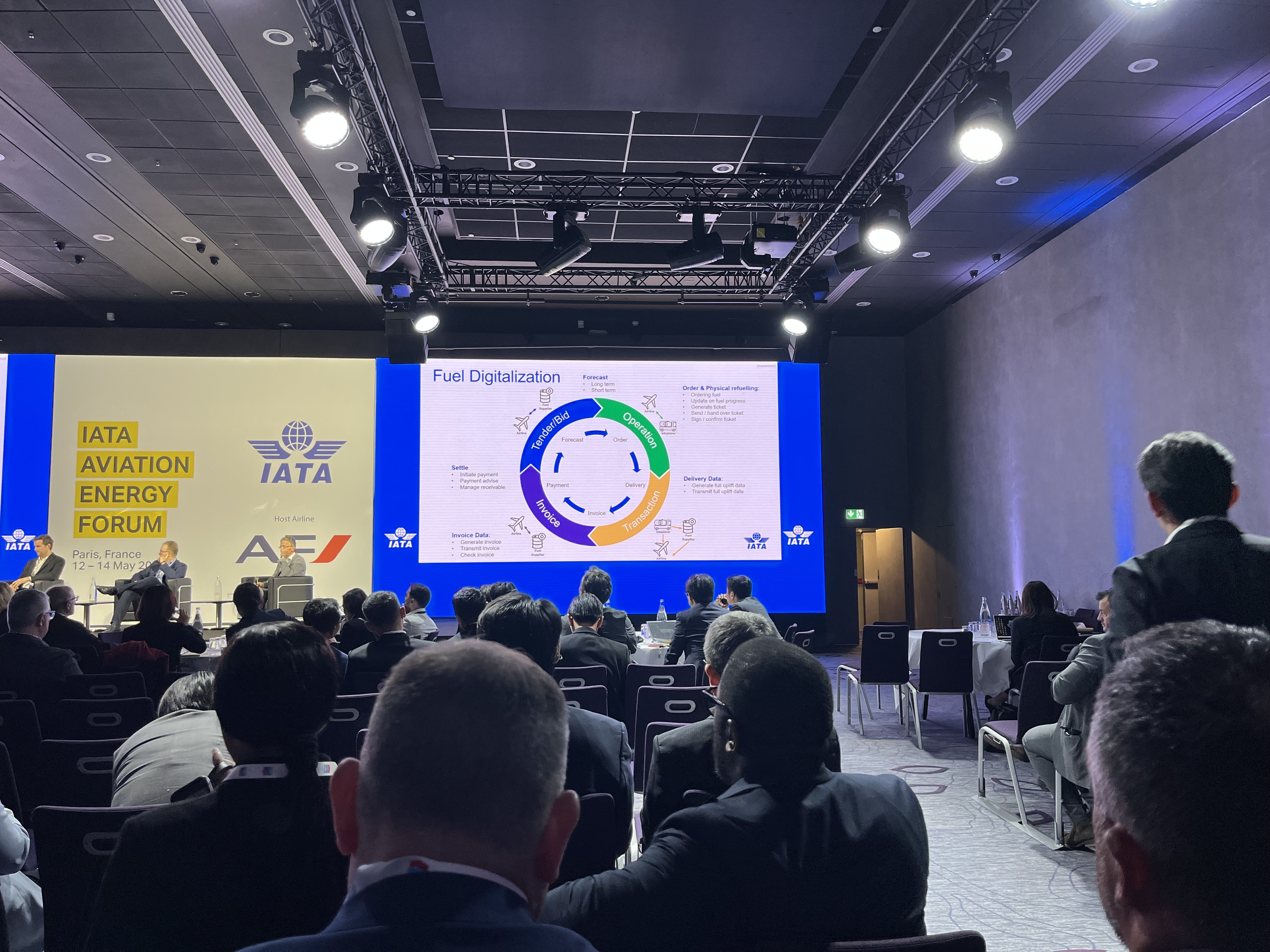
This is where the coordination problem becomes most visible – and it's the issue that went largely unaddressed on the main stage.
The primary operational challenge today isn't just moving fuel. It's coordinating the information around it.
When data is delayed or fragmented, uncertainty drives people to panic. We saw this clearly in i6 Group’s recent operational data across 61 European airports. Despite widespread anxiety over fuel shortages during recent Middle East tensions, April 2026 fuel stock levels actually jumped 62% year-over-year – with regional supply exceeding actual demand by 17%.
On the surface, a spike in inventory during a feared shortage seems contradictory. It isn’t. When operators lack real-time visibility, they protect themselves by carrying more fuel, holding larger reserves, and building massive operational buffers into the system.
Uncertainty, as one recent industry paper put it, forces operators to buy insurance in the form of fuel, time, and buffer.
None of this is to suggest that the industry isn’t moving. The energy at AEF Paris made it clear that the industry is aware of the accelerating transition ahead and is motivated to meet it.
The real question is whether our operational infrastructure is keeping pace with the complexity being placed on top of it.
Modern fueling relies heavily on a real-time flow of trusted information between airlines, airports, and suppliers. If the industry is serious about a more sustainable, resilient future, closing the gap between high-level ambition and the unglamorous work of operational alignment – from refinery to wing-tip – is where the focus needs to be.