Insights
Aviation Fuel Management in 2026: Building Resilience Against Market Volatility

Alex Mattos
Co-founder, i6 Group


In the early months of 2026, the global aviation industry finds itself in a strange paradox. Passenger numbers have officially eclipsed 2019 levels, and the industry is, for now, back in the black. However, this profitability feels remarkably thin. It is what I call a "subsidized success."
According to Willie Walsh, Director General of IATA, the primary driver of 2025's profitability was a 13% year-on-year drop in jet fuel prices compared to 2024. This "financial tailwind" has acted as a buffer, masking deep-seated operational inefficiencies across the supply chain.
But as volatility in the Middle East continues to destabilize production, that subsidy is vanishing. IATA’s Jet Fuel Price Monitor recently recorded a staggering 58.4% price surge in a single week following regional strikes. We've shifted rapidly from an era of "cheap(ish) fuel and manual processes" to one of "expensive fuel and mandatory precision."
We often think of geopolitical conflict in terms of restricted airspace, but the true cost is measured in burn-rate. Research from the University of Reading highlighted the reality of the "Ukraine Detour," which forced planes to use 13% more fuel on average to bypass Russian airspace.

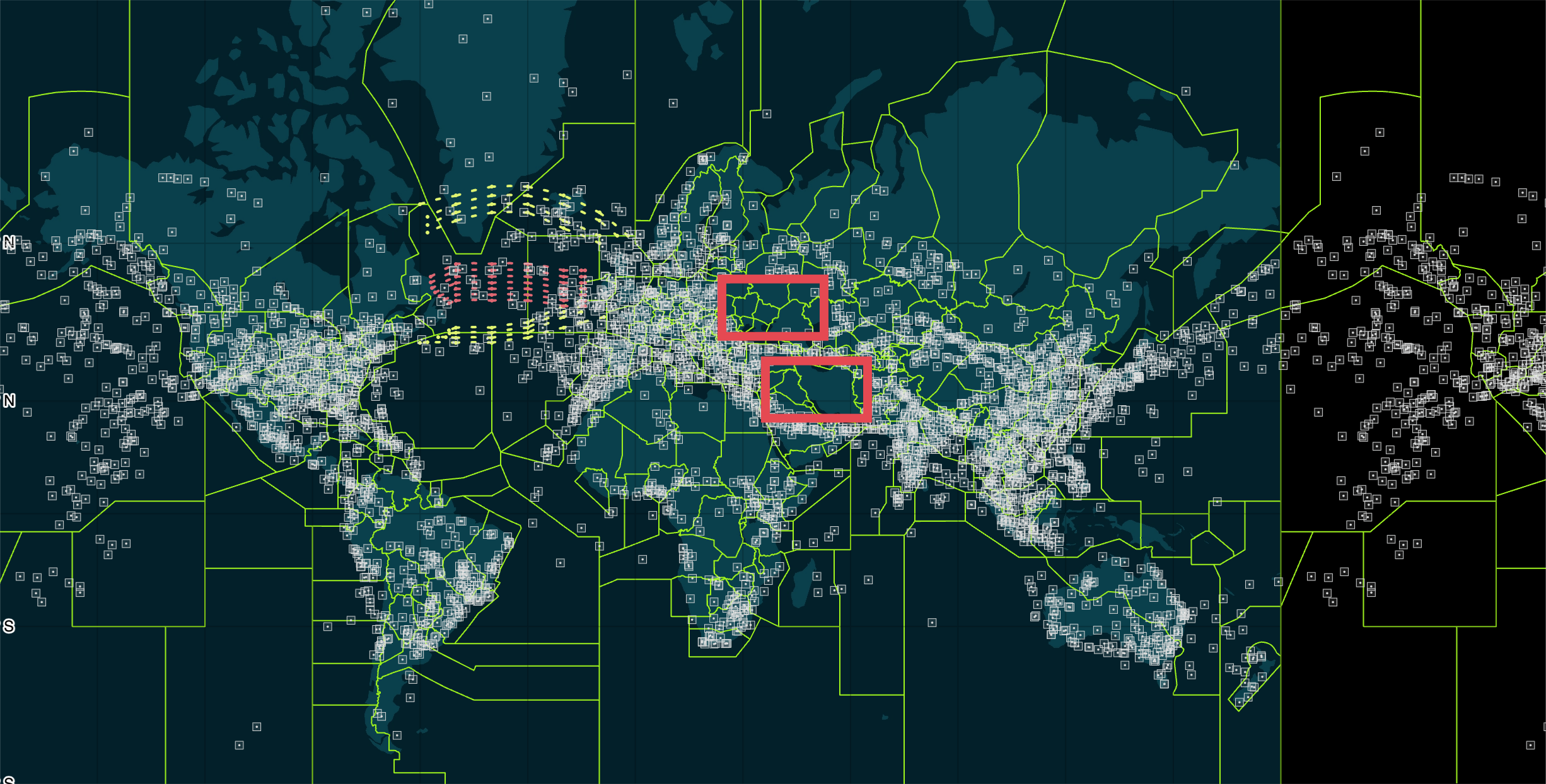
Now, we're seeing a secondary "fuel tax" emerge in the Middle East. At i6, our real-time operational data shows how quickly this has manifested. Since the conflict baseline began on February 28, we've observed an immediate 76% collapse in fuel demand across Middle East airports. Every single route we track touching the region has shown a reduction in traffic.
For major hubs like Dubai and Doha, the rerouting is significant. Industry estimates suggest that bypassing regional conflict zones can add up to 120 minutes of flying time. For a standard widebody aircraft, this detour burns an additional 8,000 to 15,000 liters of jet fuel.
---
"[Since the start of the conflict] Our dataset shows an average 10.2% increase in fuel uplift per flight on these routes." Alex Mattos, CEO and Co-Founder, i6 group.
---
However, the "zig-zag" impact extends far beyond the region itself. We've analyzed 507 unique routes that traditionally overfly Middle East airspace, including flagship corridors like London-Singapore and Amsterdam-Bangkok. Our dataset shows an average 10.2% increase in fuel uplift per flight on these routes. This isn't speculation; it is a measurable, cumulative penalty. If these conditions persist for 12 months, we've projected an additional 4.58 billion liters will be burned across the network—a $3.7 billion hit to an industry that was already running lean.
--------------------------
This isn't just about the cost of fuel; it's about the fragility of the industry's bottom line. According to IATA’s latest financial outlook, the global airline industry is expected to generate a record profit of $41 billion in 2026, but the net profit margin is expected to remain thin at just 3.9%. This equates to a buffer of approximately $7.90 per passenger.
When your profit per passenger is less than the price of an airport sandwich, and your aircraft is burning 10% more fuel just to arrive at the same gate, there is no longer any room for error on the ground. A 1% discrepancy in fuel data or a manual error in the into-plane process is no longer just a "cost of doing business." It is a direct hit to the flight's viability.
Survival in 2026 will not be determined by who has the largest fleet, but by who can build enough "digital muscle" to see their data in real-time and act on it instantly. We've moved beyond "surviving" the current volatility and started looking at how interlinked digital ecosystems can help safeguard these narrow margins. The industry's current profitability is a gift of time. We should use it to build the infrastructure required to outmaneuver the next crisis.


.png)